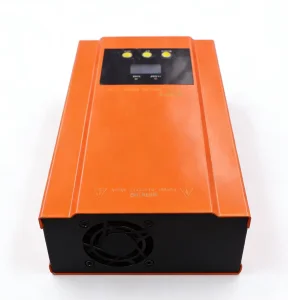
Explore our high-efficiency industrial chargers, pure sine wave power inverters, isolators, and hybrid solar controllers designed for tough commercial operational demands.
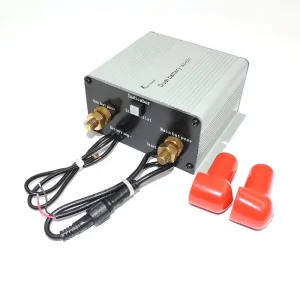
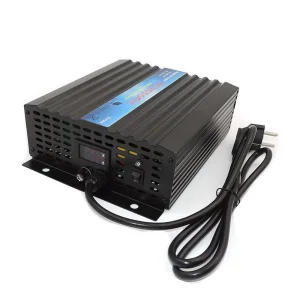
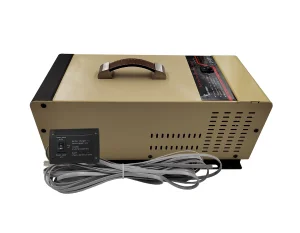
An authoritative whitepaper analysis on the electrification of golf carts, utility task vehicles (UTVs), automated guided vehicles (AGVs), and resort transportation infrastructure.
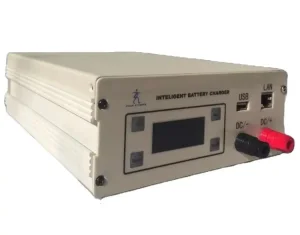
The global 36V electric mobility market is experiencing a profound architectural shift. Historically reliant on 36V flooded lead-acid battery banks (typically built via six 6V deep-cycle batteries in series), fleet operators are transitioning to Lithium Iron Phosphate ($LiFePO_4$) and advanced AGM/Gel platforms. This shift demands **high-precision smart battery chargers** capable of switching multi-stage charging curves via digital microcontrollers.
A substandard charger risks destructive thermal runaway, premature capacity degradation, and battery cell imbalance. Premium 36 Volt Golf Cart Battery Chargers integrate dynamic pulse-width modulation (PWM), active Power Factor Correction (PFC), and micro-processor temperature sensing to maximize total cycle life and lower operational Total Cost of Ownership (TCO).
For commercial golf courses, luxury resorts, industrial warehouses, and airport logistics terminals, utility golf carts are core operational assets. Fleet managers evaluate 36V battery chargers not merely as peripheral hardware, but as **critical uptime enablers**.
Fleet Economic Impact: Upinement of charger thermal efficiency from 82% to 94%+ lowers annual grid power cost per vehicle by up to $180 USD while accelerating turnaround charging times by 35%.
Modern high-quality suppliers deliver chargers featuring integrated CAN-bus communication, enabling direct handshake with Battery Management Systems (BMS) for auto-wake, precision balancing, and over-current automated shutoff.
Understanding multi-stage charging dynamics, thermal compensation, and physical plug connector engineering for 36V electric vehicles.
Industrial 36V chargers execute pre-programmed mathematical charging profiles to optimize battery chemistry response:
Heavy-duty commercial operation demands robust electrical protection to guard against field misuse and harsh grid fluctuations:
High-quality 36V chargers feature active Power Factor Correction (PFC) circuitry:
By shaping input AC current to align with input voltage waveforms, the charger eliminates reactive power waste, achieves harmonic distortion (THD) under 5%, and meets strict CISPR 14 and FCC Class B EMI radiated radiation limits.
Fleet Benefit: Allows up to 40% more chargers to run on a single facility electrical circuit without tripping main circuit breakers.
Why international OEMs, golf fleet refurbishers, and parts distributors partner with tier-1 Chinese power supply manufacturers.
Chinese power hardware factories leverage complete domestic supply chain clusters. Key high-power components—including low-RDS(on) MOSFETs, high-frequency planar transformers, heavy extruded aluminum heat sinks, and automotive-grade MCUs—are sourced within a 50km radius. Combined with high-speed automated Surface Mount Technology (SMT) lines and automated optical inspection (AOI), this creates unparalleled quality control and cost efficiency.
International buyers frequently require localized branding, proprietary plug form factors, custom output voltage tuning, and specialized housing enclosures. Our factory engineering teams provide standard OEM prototype samples within 7-10 business days.
Engineered to deliver extreme thermal durability and exact electrical output across diverse geographical and commercial operating environments.
Golf course fleets require high-density overnight batch charging. Chargers must handle wide grid voltage drops during simultaneous multi-vehicle charging sessions without overheating.
Recommended Spec: On-Board or On-Bench 36V 15A/18A Smart Charger with Automatic Float Trickle mode and Die-Cast Aluminum IP65 Casing.
Low-Speed Vehicles (LSVs) and multi-passenger people movers run frequent short trips throughout the day, requiring high-amp opportunity charging between shuttle shifts.
Recommended Spec: 36V 20A or 25A Fast Charger with LED/LCD Display Status Indicator and $LiFePO_4$ CAN-bus Integration.
Automated guided tuggers, order pickers, and floor scrubbers operating in indoor logistics centers demand fast, zero-maintenance charging with ultra-low electrical noise.
Recommended Spec: Heavy-Duty On-Board 36V 30A/40A IP67 Industrial Charger with PFC > 0.99 and Vibration-Proof Mounting Brackets.
Compare electrical performance parameters across our standard commercial 36 Volt Golf Cart Battery Charger product lines.
| Model Series | Rated DC Output | AC Input Range | Efficiency | Supported Chemistries | DC Connector Options | Ingress Rating |
|---|---|---|---|---|---|---|
| AICC-3612-SL | 36V / 12A (432W) | 90-264V AC (Global Auto) | >92% | Flooded, Gel, AGM | Crowfoot, 3-Pin Round | IP65 (Air Cooled) |
| AICC-3618-HD | 36V / 18A (648W) | 100-240V AC (PFC) | >93.5% | Flooded, AGM, $LiFePO_4$ | Powerwise, EzGo D-Plug | IP66 (Sealed) |
| AICC-3625-LT | 36V / 25A (900W) | 180-260V AC / 90-132V AC | >94.0% | $LiFePO_4$, NMC, Smart Lead | Anderson SB50 / Club Car 3-Pin | IP67 (Fully Potted) |
| AICC-3635-IND | 36V / 35A (1260W) | 100-240V AC Active PFC | >95.0% | Custom LiFePO4 + CAN-bus | Anderson SB175 / Direct Cable | IP67 Heavy Industrial |
Selecting the exact DC plug interface is vital for plug-and-play fleet replacement. We engineer stock and custom molded cables for all major golf cart brands:
36V Powerwise 2-Pin Plug, D-Shaped 2-Pole Rectangular Plug, and legacy Crowfoot 2-Blade connector.
3-Pin Round molded connector, 36V Crowfoot, and direct terminal eyelets for modified on-board setups.
2-Pin Mac Plug, 3-Pin Nabson Style, 2-Blade Crowfoot, and high-current Anderson SB50 / SB175 connectors.
Discover how Gallium Nitride (GaN) semiconductors, IoT cloud telemetry, and bidirectional power flow are shaping the future of electric utility mobility.
Replacing conventional Silicon MOSFETs with GaN semiconductors enables 3x faster switching frequencies, reducing internal inductor size by 40% while pushing total power density above **1.5 W/cm³**. The result is an ultra-lightweight, ultra-compact charger housing.
Future 36V smart chargers integrate Bluetooth, Wi-Fi, or cellular NB-IoT modules. Fleet managers track battery health metrics, state-of-charge percentage, total kWh draw, and real-time fault warnings directly via web dashboards.
To support off-grid golf courses and eco-resorts, next-generation 36V chargers feature integrated MPPT solar inputs, allowing direct DC solar charging from rooftop panels without requiring inefficient intermediate AC inversion.
Authoritative technical solutions to common procurement, engineering, and battery maintenance questions.
For a standard 36V flooded lead-acid system (consisting of six 6V batteries in series), the absorption charging peak voltage typically reaches **$44.1\text{V}$ to $44.4\text{V}$** ($2.45\text{V}$ per cell) at $25^\circ\text{C}$, before dropping to a float voltage of **$39.6\text{V}$** ($2.20\text{V}$ per cell).
For a 36V $LiFePO_4$ pack (typically a 12-cell series configuration, 12S), the nominal pack voltage is $38.4\text{V}$. The maximum charger absorption cut-off voltage is **$43.8\text{V}$** ($3.65\text{V}$ per cell). Never use a lead-acid charger on a Lithium pack unless the charger has an explicit $LiFePO_4$ algorithm mode, as desulfation high-voltage spikes will trigger the Lithium BMS protection circuit or damage cells.
A charger failing to automatically turn off usually points to one of three issues:
The ideal charging current is determined by battery capacity ($Ah$ rating) and required turnaround time:
Rule of Thumb: Charging current should equal 10% to 20% of total Amp-Hour ($Ah$) capacity for lead-acid, and up to 30%-50% for Lithium.
Lead-acid electrochemistry is highly sensitive to ambient temperature. As battery temperature rises, chemical reactivity increases and internal resistance decreases, lowering the voltage required to push current into the battery.
Without temperature compensation (typically **$-3\text{mV}/^\circ\text{C}/\text{cell}$**), a charger running in a $40^\circ\text{C}$ summer garage will severely overcharge and boil the electrolyte. Conversely, in sub-zero winter temperatures, an uncompensated charger undercharges the pack, causing rapid sulfation accumulation. Intelligent chargers utilize external NTC thermistors affixed directly to the battery post for dynamic voltage adjustment.
Yes, provided the charger is explicitly rated for On-Board Industrial Applications. An on-board charger must possess an IP67 waterproof rating, anti-vibration silicon potting surrounding electrical inductors/capacitors, and an integrated AC inlet plug on the vehicle body.
In addition, on-board chargers must feature an **Interlock Relay output**, which physically prevents the golf cart drive motor from engaging while the charger AC cord is plugged into the wall outlet.
For compliant commercial distribution, importers must verify:
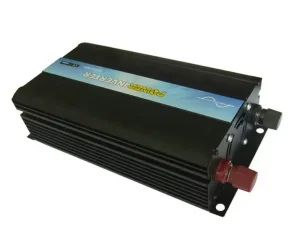
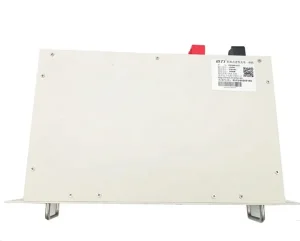
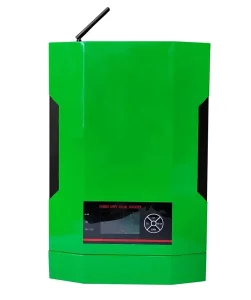
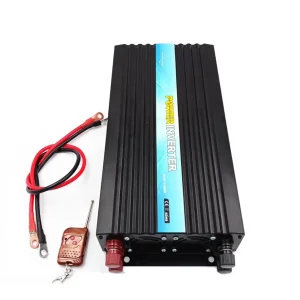
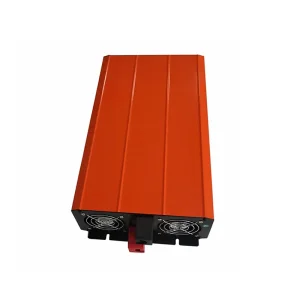
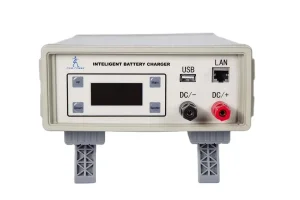
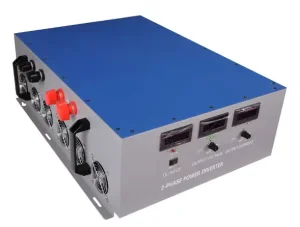
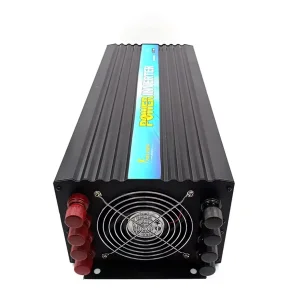
Expand your fleet hardware sourcing with our high-reliability pure sine wave inverters, solar charge controllers, and smart DC conversion gear.
Contact our engineering sales team today for bulk wholesale pricing, custom firmware integration, localized DC plug molding, and ISO-certified factory production schedules.