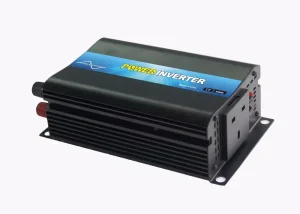
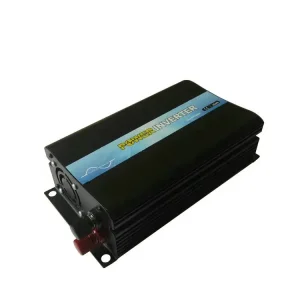
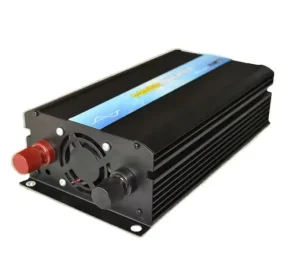
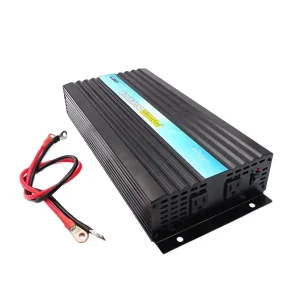
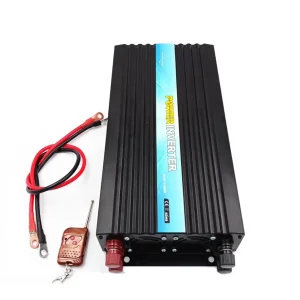
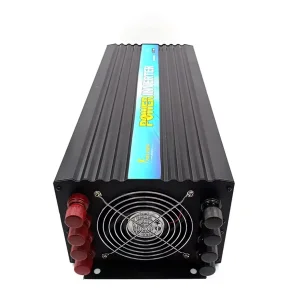
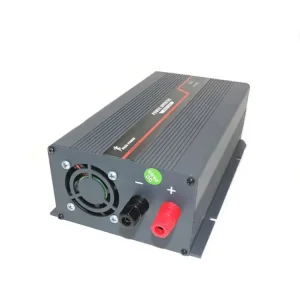
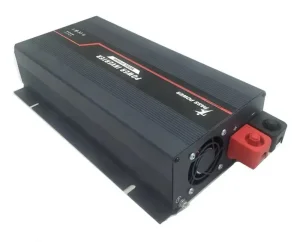
Explore our OEM/ODM portfolio engineered with high-density pure sine wave switching technology, robust dynamic surge suppression, and intelligent protection circuits.
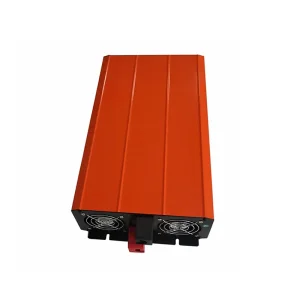
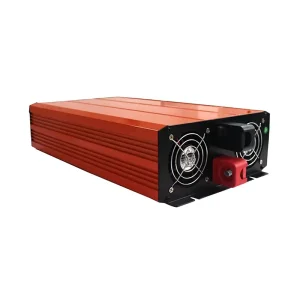
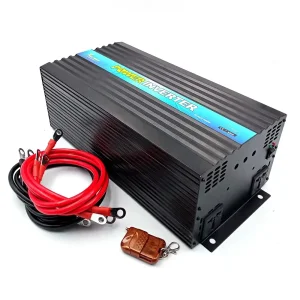
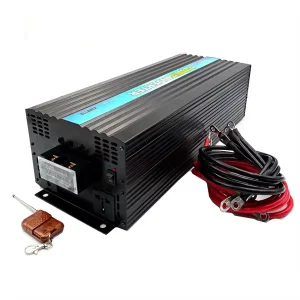
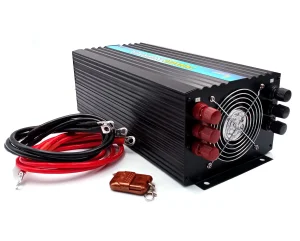
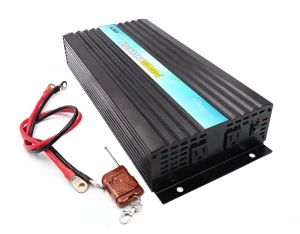
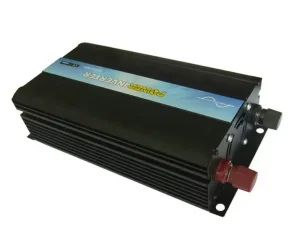
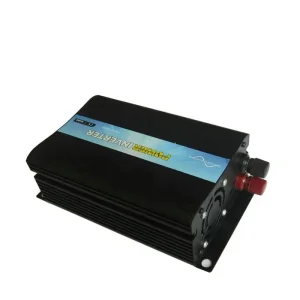
The global transition toward decentralized energy storage, electromobility, industrial off-grid infrastructure, and renewable integration has accelerated the demand for high-density power conversion devices. Within the range of 300W to 8000W, high-frequency (HF) pure sine wave inverters have superseded traditional low-frequency, heavy-iron transformer topologies in over 82% of commercial and residential installations worldwide.
High-frequency inverter architectures leverage multi-stage power conditioning. Instead of converting low-voltage DC directly into line-frequency AC via massive 50Hz/60Hz laminated steel transformers, HF systems utilize high-speed Pulse Width Modulation (PWM) to step up DC voltage across compact ferrite core transformers operating at ultrasonic switching frequencies (typically 20 kHz to 100 kHz).
| Performance Metric | High-Frequency (HF) Inverter (300W–8000W) | Low-Frequency (LF) Inverter | Engineering Benefit of HF Design |
|---|---|---|---|
| Magnetics & Transformer | Compact High-Permeability Ferrite Core | Heavy Grain-Oriented Silicon Steel | Drastic weight reduction, zero audible hum |
| Conversion Efficiency | 91% – 95% across 40%-90% load range | 82% – 88% due to core hysteresis losses | Higher battery energy retention, cooler running |
| No-Load Idle Power Draw | < 0.6 Amps at 12V (Approx. 4W - 12W) | 1.8A – 4.5Amps at 12V (25W - 60W) | Minimal standby drain on solar storage banks |
| Transient Surge Management | Digital Soft-Start DSP ramping (2x Rated Power) | Magnetic Saturation Storage (3x Rated Power) | Protects delicate loads & prevents battery voltage collapse |
| Total Harmonic Distortion (THD) | Pure Sine Wave < 2.5% (Filtered LC Stage) | Modified or Pure Sine < 3% to 5% | Medical & telecommunications instrument safe |
To understand why high-frequency 300W to 8000W pure sine wave inverters dominate modern power engineering, we must analyze the two-stage power conversion process: the High-Voltage DC-DC Push-Pull/Full-Bridge Boost Stage, followed by the High-Voltage DC-AC Full-Bridge Inversion Stage.
Low-voltage DC input (12V, 24V, 48V, or 96V) passes through low-ESR solid electrolytic capacitor banks to attenuate input ripple current. Ultra-low $R_{DS(on)}$ Power MOSFETs chop the DC current into high-frequency pulses (45 kHz – 65 kHz) feeding into custom planar or E-core ferrite transformers, stepping up the bus voltage to a steady 380V–420V DC intermediate bus.
The 400V DC high-voltage bus feeds an H-bridge network of high-speed Insulated Gate Bipolar Transistors (IGBTs) or Silicon Carbide (SiC) MOSFETs driven by a 32-bit ARM Cortex micro-controller. Utilizing Sinusoidal Pulse Width Modulation (SPWM), the switches modulate current at high frequencies, creating an equivalent sine wave fundamental frequency (50Hz/60Hz).
A low-pass LC filter (comprising high-temperature toroid inductors and metalized polypropylene film capacitors) strips away the 50kHz switching carrier component, yielding a clean, ultra-low harmonic pure sine wave output suitable for sensitive medical, audio, and micro-processor controlled electronics.
The power loss within a high-frequency inverter is predominantly dictated by conduction losses in the primary switching MOSFETs and switching losses during transient transitions. Engineering teams optimize thermal dissipation using the following mathematical model:
By utilizing wide-bandgap semiconductors such as Gallium Nitride (GaN) or Silicon Carbide (SiC) in 3000W–8000W configurations, switching times ($t_{rise}, t_{fall}$) are reduced from 45 nanoseconds down to under 8 nanoseconds, cutting switching losses by over 75% and enabling fanless operation under 30% load conditions.
Deploying 300W to 8000W high-frequency inverters across international B2B markets requires strict compliance with regional grid parameters, grounding conventions, safety directives, and environmental stresses.
Grid Voltage: 110V / 120V AC ±5% | 60Hz ±0.1Hz
Primary Applications: Overland Vans, RV Off-Grid Power, Commercial Work Trucks, Agricultural Solar Pumping, Emergency Backup.
Compliance Mandates: UL 458 (Mobile Power Applications), UL 1741 (Off-Grid Solar Integration), FCC Part 15 Class B EMI Radiated Emissions control to ensure zero interference with marine VHF or CB radio signals.
Grid Voltage: 220V / 230V / 240V AC | 50Hz ±0.1Hz
Primary Applications: Off-Grid Microgrids, Small Wind Turbines, Remote Telecom Towers, Residential Energy Storage Systems (ESS).
Compliance Mandates: CE Low Voltage Directive (LVD EN62109-1/2 safety standard), CE EMC (EN61000-6-1/3 immunity/emissions), RoHS Directive for lead-free hazardous substance restriction.
Input Ranges: Wide DC Input Latitudes (10V–16V for 12V; 40V–64V for 48V systems).
Primary Applications: Desert Mining Camps, Island Micro-Hydro, Equatorial Solar Home Systems (SHS).
Environmental Engineering: Conformal PCB coating protecting against high-humidity condensation, saline air corrosion, and airborne mineral dust ingress (IP30/IP54 rated chassis enclosures).
As an established manufacturer, our facility specializes in white-label engineering and custom electrical topology modification for original equipment manufacturers, system integrators, and international distributors.
Customization options include non-standard DC inputs (such as 36V, 72V, 96V, or 380V High Voltage DC) and tailored AC output soft-start profiles designed to ramp voltage from 0V to 230V over 1.5 to 5.0 seconds, neutralizing severe initial locked-rotor current (LRC) in electric motors.
Integration of industrial CAN-bus, RS485 (Modbus-RTU), or Bluetooth 5.0 mesh wireless communications modules allowing full remote telemetry monitoring of real-time DC voltage, AC load percentage, internal heatsink temperatures, error code diagnostics, and remotely controlled AC power switching.
Optimized low-voltage cutoff (LVD) and automatic recovery threshold programming tailored specifically for Lithium Iron Phosphate (LiFePO4), NMC, or AGM/Gel battery chemistries, preventing premature Battery Management System (BMS) protection tripping under severe load spikes.
The future of high-frequency power inversion lies in intelligent edge-computing integration. Upcoming generations will feature AI-assisted predictive thermal throttling, real-time wave-shaping via adaptive machine learning algorithms, and high-frequency GaN-on-Silicon power switches reaching 97% efficiency barriers while reducing physical footprint by another 40%.
Explore our expanded series of residential, mobile, and off-grid high-frequency pure sine wave power inverters available for wholesale distribution and OEM manufacturing.