


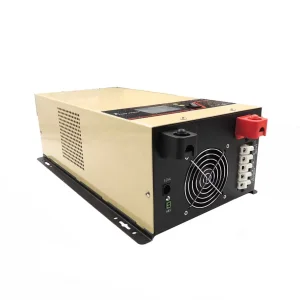
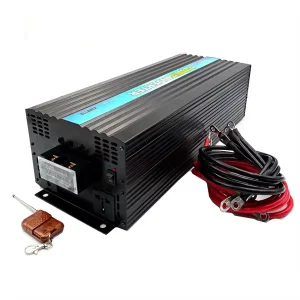
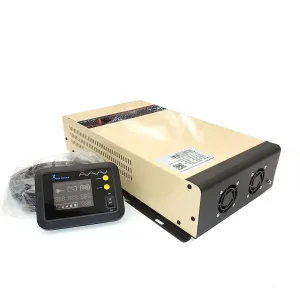
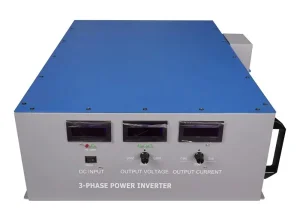
As energy transition mandates accelerate across North America, Europe, and emerging global markets, the demand for high-reliability off-grid power conversion systems has evolved. Modern industrial applications require far more than basic direct current (DC) to alternating current (AC) inversion. Today's commercial deployment vectors demand integrated bidirectional power conversion hubs capable of seamless shore-power grid transfer, multi-stage intelligent battery charging (covering LiFePO4, Ternary Lithium, and traditional Lead-Acid chemistries), and active power-factor correction.
As a premier OEM DC to AC inverter with charger manufacturer and factory, Suzhou Maili Electrical Appliance Co., Ltd. (operating Pass Power Inverters) engineers advanced energy conversion systems. Serving as a crucial bridge between raw DC storage (ranging from 12VDC, 24VDC, and 48VDC up to high-voltage 380VDC buses) and sensitive AC utility loads, our integrated inverter-chargers serve critical roles across commercial mobile platforms, emergency medical vehicles (EMS), marine vessels, off-grid solar microgrids, and industrial backup systems.
Deploying separate inverter and battery charger units introduces impedance bottlenecks, multiple points of failure, ground-loop issues, and redundant thermal dissipation losses. An integrated DC to AC inverter with charger unifies the power stage, utilizing a single DSP control loop to manage both bi-directional power flow and automatic line-to-battery transfer switching, yielding a 18% reduction in total footprint and an overall system reliability improvement measured via MTBF (>100,000 hours).
When specifying OEM power conversion hardware, enterprise procurement officers and lead system engineers must evaluate the operational trade-offs between Low-Frequency (LF) Toroidal Transformer topologies and High-Frequency (HF) Switching platforms. Maili Electric operates dedicated manufacturing lines for both topologies to precisely align with client load parameters.
Utilizes a massive copper toroidal transformer operating at line frequency (50Hz/60Hz). Offers unmatched galvanic isolation and extreme current handling capability for heavy inductive loads.
Employs high-speed power MOSFETs or IGBTs switching at tens of kilohertz (20kHz - 100kHz) before stepping up voltage via compact ferrite cores.
| Performance Specification | Low-Frequency Toroidal Platform | High-Frequency Switch-Mode Platform |
|---|---|---|
| Primary Power Stage Topology | Push-Pull / Full Bridge with Heavy Line-Frequency Transformer | High-Speed SPWM Inverter with Ferrite Step-Up & H-Bridge Output |
| Inverter Output Waveform | Pure Sine Wave (THD < 2.5% at linear load) | Pure Sine Wave (THD < 3.0% at linear load) |
| Peak Surge Rating | 3x Rated Capacity for 20s (e.g., 3000W handles 9000W peak) | 2x Rated Capacity for 100ms |
| Integrated Battery Charger Algorithm | 4-Stage Smart Charge (Bulk, Absorb, Float, Equalize / LiFePO4 Wakeup) | 3-Stage Smart Charge with Configurable Voltage Thresholds |
| Automatic Transfer Switch (ATS) | Built-in Ultra-Fast Relay (< 8ms transfer to AC utility/shore) | Solid-State / Relay Transfer (< 10ms transfer) |
| Target Application Spectrum | Motor Homes, Air Conditioners, Industrial Pumps, EMS Vehicles | Consumer RVs, Telecommunications, Mobile Electronics, PV Backup |
Operating from our 2,770 m² ISO 9001:2015 certified facility in Suzhou, Jiangsu Province—China’s premier high-tech manufacturing corridor—Maili Electric delivers structural cost and performance advantages for global enterprise brands.
We directly contract with Tier-1 semiconductor vendors for imported and domestic SiC/Silicon IGBTs, Infineon MOSFETs, and Texas Instruments DSP microcontrollers. Direct factory component sourcing protects our OEM partners against global supply chain volatility while locking in bulk price efficiencies.
Our production facility features high-speed Surface Mount Technology (SMT) lines, automated conformal coating application for moisture/corrosion protection, and computer-controlled toroidal transformer copper winding machines. This ensures zero variation in wire tension, thermal distribution, and magnetic saturation limits.
Every manufactured inverter-charger undergoes stringent quality gates: incoming raw material inspection (IQC), in-process PCB automated optical inspection (AOI), 100% full-power thermal burn-in aging for 4-12 hours in elevated temperature chambers, and final computer-assisted functional test (FQA).
Deploying OEM DC to AC inverter chargers internationally requires strict adherence to localized electrical codes, grid frequencies, input/output socket geometry, and electromagnetic compatibility (EMC) regulations.
For US, Canadian, and Mexican markets, Maili Electric manufactures native 120VAC single-phase and 120V/240V L1+L2 split-phase low-frequency inverters capable of interfacing with dual hot lines.
Designed to match European CEE 7/7, UK BS 1363, and Australian AS/NZS 3112 standards, serving residential, commercial vehicle, and marine sectors.
We specialize in non-standard engineering projects and private-label manufacturing programs. Enterprise buyers can customize every critical subsystem of the DC to AC inverter charger line.
Custom DC input buses (12V, 24V, 48V, 72V, 96V up to 380VDC high-voltage platforms). Selectable charging currents from 10A up to 120A continuous.
Tailored charging profiles for LiFePO4, NMC, AGM, GEL, and Lead-Carbon batteries, featuring 0V emergency lithium BMS reactivation logic.
RS485, CANbus, Modbus RTU interface integration allowing real-time telemetry streaming to master vehicle controllers or cloud dashboards.
Custom extruded aluminum color anodization, silk-screened client logos, custom LCD display UI layouts, packaging design, and heavy-duty IP54/IP65 outer boxes.
Our pure sine wave DC to AC inverter-chargers are deployed across harsh operational environments worldwide. Below are the primary deployment frameworks:
In RV electrification, our 12V/24V low-frequency inverter-chargers (1.5kW to 6kW) allow travel trailer owners to seamlessly power roof-top air conditioners, microwave ovens, and induction cooktops off battery storage. When plugged into shore power, the integrated ATS switches the cabin load to grid power while recharging the house battery bank via a multi-stage intelligent charge cycle.
Ambulances, fire command trucks, and mobile service workshops require non-negotiable clean power. Our pure sine wave technology produces ultra-clean AC power (THD < 2.5%), ensuring life-support medical telemetry, defibrillators, mobile laptops, and high-draw hydraulic tools operate without electromagnetic interference or unexpected power resets.
Paired with solar photovoltaic arrays, our hybrid inverter-chargers automatically prioritize clean solar harvesting. In low-sun conditions, the internal charger initiates generator auto-start contacts or connects to utility power to maintain continuous power uptime for remote cell towers and off-grid residential compounds.
As a forward-looking OEM manufacturer, Maili Electric actively integrates emerging technological advancements into our next-generation production roadmap:
Transitioning high-frequency conversion stages from traditional Silicon MOSFETs to Silicon Carbide (SiC) and Gallium Nitride (GaN) switches reduces thermal losses by up to 40%, enabling higher switching frequencies, smaller toroidal magnetics, and overall operational efficiency exceeding 97%.
Future mobile power networks require dual-directional energy flow. Our R&D division is standardizing bidirectional DC-AC-DC conversion pathways that allow electric vehicles and heavy battery banks to feed energy back into home microgrids or commercial facilities during peak utility pricing periods.
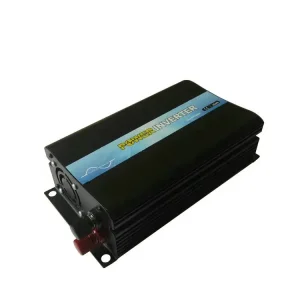
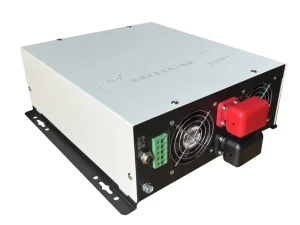
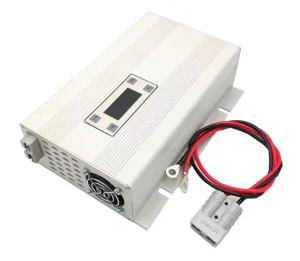
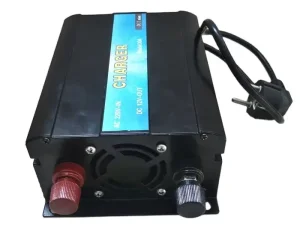
Technical answers designed for enterprise purchasers, power electronics engineers, and B2B importers evaluating DC to AC inverter chargers.
The fundamental technical distinction lies in the internal transformer topology and operating frequency. A low-frequency inverter charger utilizes a copper toroidal transformer operating at 50Hz/60Hz line frequency. This provides extreme peak surge capacity (up to 300% rated capacity for 20 seconds) and total galvanic isolation between DC storage and AC loads, making it indispensable for high-inductive loads like air conditioners, compressors, and pumps.
Conversely, a high-frequency inverter charger uses electronic switching (20kHz–100kHz) and compact ferrite transformers. It offers a much higher power density, significantly lighter weight (up to 60% reduction), and higher baseline efficiency for linear electronic loads, but has lower peak motor-starting surge capability.
Maili Electric’s integrated chargers feature microcontroller-controlled multi-stage algorithms (Constant Current / Bulk, Constant Voltage / Absorption, Float, and Equalization/Wakeup). For Lithium Iron Phosphate (LiFePO4) chemistries, the charger profile omits equalization floating to prevent overcharging degradation and includes a dedicated 0V BMS activation signal that sends precise pulse waves to reset tripped internal battery protection circuits.
We offer comprehensive OEM/ODM customization: custom DC bus voltages (12VDC to 380VDC), custom AC output voltages (100V, 110V, 120V, 220V, 230V, 240V split-phase or 380V 3-phase), adjustable charger current thresholds, custom communication protocols (CANbus, Modbus RS485, Bluetooth/Wi-Fi smart dongles), client-branded silk-screening, custom metal chassis colors, and specialized packing boxes.
Our factory operates under an ISO 9001:2015 certified Quality Management System. Individual inverter charger product lines hold CE certifications (Low Voltage Directive 2014/35/EU and EMC Directive 2014/30/EU), RoHS compliance for environmental safety, IP30 protection ratings, and SGS inspection verification reports. Custom certification support (UL 1741, SAA, CB) can be executed upon request for OEM projects.
Our heavy-duty low-frequency inverter-chargers feature an integrated high-speed mechanical ATS capable of switching from AC grid/shore power to battery inversion mode in less than 8 milliseconds (< 8ms). This ultra-fast switching threshold guarantees that sensitive electronics, IT servers, and emergency vehicle telemetry remain online without rebooting during power outages.
